
Vagina
Elastic muscular canal for copulation, birth, and menstruation.

I, Michael E. Arth, took this photo of Andy Warhol's 1975 drawing to me in the d · CC0
The vagina is the elastic, muscular reproductive organ of the female genital tract in mammals, including humans. It serves as the canal for copulation, childbirth, and the passage of menstrual flow. The term derives from Latin vāgīna, meaning 'sheath' or 'scabbard,' and is often colloquially misused to refer to the vulva or female genitals in general.
- type
- Anatomical structure
- location
- Extends from vulval vestibule to cervix
- length
- Front wall approx. 7.5 cm, back wall approx. 9 cm
- function
- Copulation, childbirth, menstrual flow
- etymology
- Latin vāgīna, 'sheath' or 'scabbard'
Lore & Background
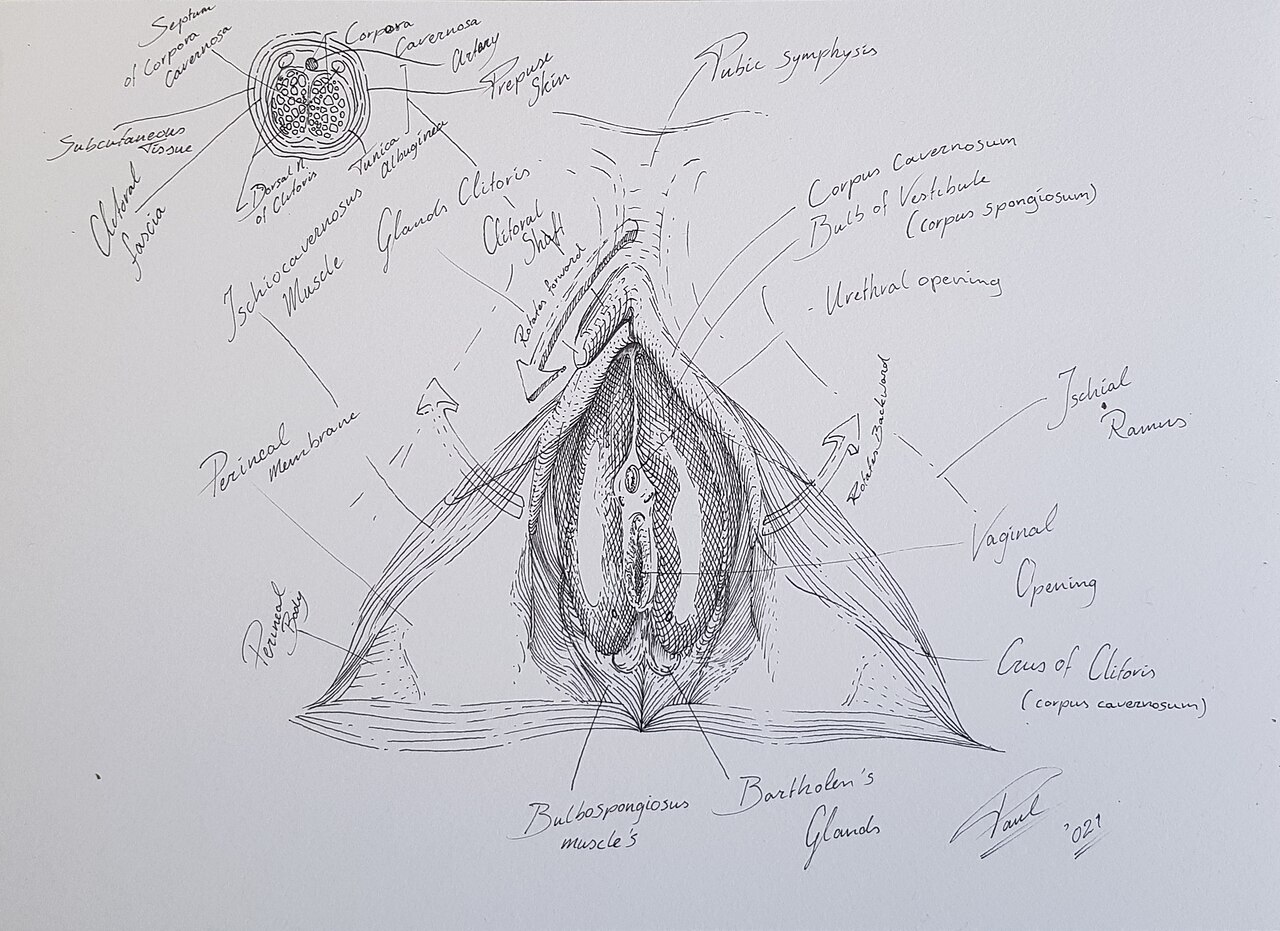
The vagina is an elastic, muscular canal that extends from the vulva to the cervix. When not sexually aroused, it is a collapsed tube with an H-shaped cross section. The vaginal opening, or introitus, is normally partly covered by the hymen, a thin layer of mucosal tissue. The hymen may be broken by intercourse, childbirth, disease, injury, medical examination, masturbation, or physical exercise, so virginity cannot be determined by its examination. The vagina varies in length among women of child-bearing age, with the front wall approximately 7.5 cm and the back wall approximately 9 cm long. During sexual arousal, the vagina expands in both length and width.
Reader's Guide
The vagina has evoked strong reactions in societies throughout history, including negative perceptions, cultural taboos, and use as a symbol for female sexuality, spirituality, or regeneration of life. In common speech, the word 'vagina' is often used incorrectly to refer to the vulva or female genitals in general, which can cause medical or legal confusion. Researchers endorse correct terminology for the vulva to combat sexual and psychological harm. The vagina's structure includes a mucosa of stratified squamous epithelium, a smooth muscle layer, and an outer adventitia. Its development involves the vaginal plate, with conflicting views on embryologic origin—some attributing the upper two-thirds to the Müllerian duct and the lower part to the urogenital sinus, while others argue the epithelium derives solely from the urogenital sinus. These debates stem from the complexity of interrelated tissues and the absence of a matching animal model.
Did You Know?
- The term vagina comes from Latin vāgīna, meaning 'sheath' or 'scabbard'.
- The vaginal introitus is normally partly covered by a thin layer of mucosal tissue called the hymen.
- The collapsed vagina has an H-shaped cross section due to its lateral walls being relatively more rigid.
- The length of the vagina varies, with the front wall approximately 7.5 cm and the back wall approximately 9 cm long.
Terminology and Cultural Framing
The vocabulary surrounding sexual activity is remarkably layered. The term coitus traces back to the Latin coitio or coire, carrying the sense of coming together or going together, and historically referred to a range of sexual acts before settling primarily on penile-vaginal penetration. Copulation leans more toward the reproductive act, especially in non-human contexts, while intercourse functions as a broader umbrella. The World Health Organization has noted that non-English languages and cultures employ distinct words for sexual activity, each carrying slightly different connotations. Beyond clinical language, everyday speech is peppered with slang and euphemisms—words like fuck, screw, shag, or the softer sleep together—while some legal codes in certain countries use the formal phrase carnal knowledge. The moment of first sexual intercourse has its own term, sexarche, and the specific act of penile insertion into the vagina is called intromission or, in Latin, immissio penis. This web of terminology reflects how deeply culture, law, and biology intertwine in how societies talk about the most fundamental of intimate acts.
The Spectrum of Sexual Activity
Sexual activity spans a wide continuum beyond the single act most commonly referenced. While penile-vaginal penetration remains the default reference point in research and everyday language, other penetrative forms—including anal sex, oral sex, fingering, and the use of dildos or vibrators—are equally recognized. Health professionals emphasize that the desire for these activities is rooted in natural human instinct and typically serves both physical-emotional pleasure and the strengthening of interpersonal bonds. The distinction between penetrative and non-penetrative sex has given rise to the label outercourse, though some definitions and individuals still classify non-penetrative acts as sexual intercourse. Different communities draw the line differently: some gay men regard frot or oral contact as their primary sexual activity while reserving the term intercourse for penile-anal penetration; lesbians may categorize oral sex or fingering as intercourse, or view tribadism as their central form of sexual expression. Scholars Lerner and Steinberg have raised concern that the cultural preoccupation with penile-vaginal sex leads researchers to rarely disclose how they define the very act they study.
Legal and Religious Boundaries
The regulation of sexual behavior extends well beyond the bedroom into the realms of law and faith. Numerous jurisdictions impose restrictions on specific acts, including adultery, incest, sexual activity involving minors, prostitution, rape, zoophilia, sodomy, and premarital or extramarital sex. These legal frameworks shape not only criminal codes but also broader public policy. Religious beliefs add another layer of influence, guiding personal decisions about virginity, the timing of sexual activity, and the moral boundaries of intimate relationships. While views on sexuality vary significantly across different religions and even among sects within the same faith, certain themes recur—most notably the prohibition of adultery. The interplay between statutory definitions of sexual penetration, religious doctrine, and individual moral reasoning creates a complex landscape in which what constitutes permissible or prohibited sexual conduct is never settled by a single authority. Health professionals, meanwhile, advocate safer-sex practices to mitigate the risk of sexually transmitted infections, adding a public-health dimension to an already multi-layered set of considerations.
Animal Copulation and Social Bonding
In the non-human animal world, the reproductive act is more commonly termed copulation, and sperm transfer can occur through means other than vaginal penetration, such as cloacal copulation observed in certain species. For the majority of non-human mammals, mating is tightly synchronized with estrus—the peak-fertility window in the female's reproductive cycle—to maximize the likelihood of successful impregnation. Yet several species break from this purely reproductive pattern. Bonobos, dolphins, and chimpanzees are documented engaging in sexual activity regardless of whether the female is in estrus, and they also participate in same-sex sexual encounters. Researchers presume that, as with humans, a significant driver of this behavior in these animals is pleasure rather than reproduction alone. Sexual activity in these species also functions as a mechanism for strengthening social bonds within the group, suggesting that the intimate, pleasure-driven dimension of sex is not uniquely human but is shared across a range of intelligent, socially complex animals.
Gallery



Frequently Asked Questions
What is the vagina?
It is a flexible, muscle-lined canal that forms part of the female reproductive system in mammals, including humans. It acts as a passageway for sexual intercourse, delivery of a baby, and the exit of menstrual blood.
Where exactly is the vagina positioned in the body?
It stretches from the vestibule at the external genital opening all the way up to the cervix of the uterus. The front wall measures roughly 7.5 cm while the posterior wall is a bit longer at about 9 cm.
What does the word 'vagina' originally mean?
The term comes from the Latin vāgīna, translating to 'sheath' or 'scabbard.' In everyday speech, people often mistakenly use the word to describe the entire external female genital area (the vulva) rather than just the internal canal.
What are the main biological roles of the vagina?
It serves three primary purposes: acting as the receiving canal during copulation, functioning as the birth canal during delivery, and providing the pathway for menstrual flow to exit the body. All of these roles depend on its elastic, muscular tissue.
How is the vagina classified anatomically?
It is categorized as an anatomical structure—specifically an elastic muscular canal—rather than a discrete organ in the traditional sense. It connects the external vestibule to the internal cervical opening.
More in Reproduction & Development 1-19
Spotted an error? Know more?
This is a living reference — every entry is fact-audited, and reader corrections feed straight into our audit queue. Suggest an edit · See this site's audit record